Food Price Indices
Conflict Impact on Food
Iran is a significant producer of natural gas (used for fertilizer production). Conflict-driven energy price spikes cascade into higher food production costs globally.
FAO Food Price Index (Base: 2014-16 = 100)
xychart-beta
    title "FAO Food Price Index"
    x-axis ["03-01", "05-01", "07-01", "09-01", "11-01", "01-01", "03-01"]
    y-axis "Index (2014-16=100)" 0 --> 153
    line [127.2, 127.1, 129.8, 128.6, 125.2, 124.2, 140.7]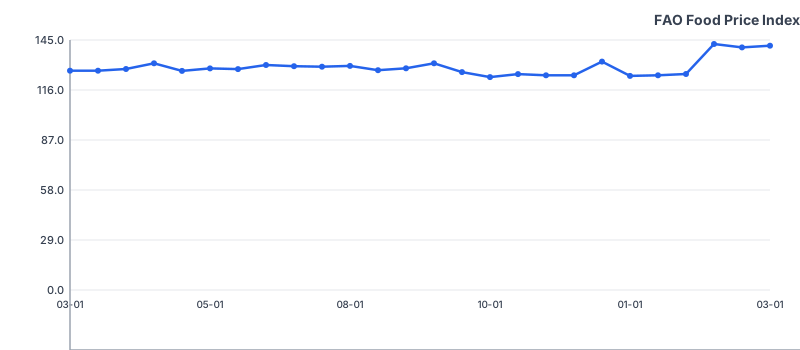
Current Indices
| Index | Value | Updated |
|---|---|---|
| FAO Food | 141.7 | 2026-03-01 |
| Cereals | 128.5 | 2026-03-01 |
| Oils | 145.8 | 2026-03-01 |
| Dairy | 131.4 | 2026-03-01 |
| Meat | 126.4 | 2026-03-01 |
| Sugar | 139.6 | 2026-03-01 |
Food Market News
- 2026-03-21 — Iran lets grain ships through Hormuz to shore up food supply Iran reportedly allowed grain-carrying vessels to transit the Strait of Hormuz, signaling a selective easing of the blockade to prevent a humanitarian food crisis and maintain diplomatic leverage. The move likely provided modest relief to global wheat and corn futures by reducing fears of a complete supply cutoff for Middle Eastern and South Asian grain imports, though it did nothing to alleviate the ongoing disruption to oil and LNG shipments. Market watchers noted that the selective passage underscored Iran's strategy of weaponizing Hormuz access commodity by commodity, keeping energy markets under maximum pressure while deflecting criticism over food security.
- 2026-03-21 — Cargill uses AI to get more meat from the bone as beef prices soar Cargill deployed artificial intelligence systems to optimize beef processing yields, extracting more usable product per carcass as cattle prices hit elevated levels driven by tight herd supplies. The move reflected broader food industry pressure to offset rising input costs — including feed, fuel, and transport — that had squeezed processor margins throughout the supply chain. For market watchers, wider adoption of yield-optimization technology could partially buffer retail beef price inflation, though it addressed efficiency rather than the underlying cattle supply deficit.
- 2026-03-20 — European Gas Price Set for 20% Weekly Jump on Qatar’s LNG Outage European natural gas prices surged approximately 20% in a single week following the outage at Qatar's Ras Laffan LNG terminal, which handles roughly a third of global LNG trade. The spike directly threatened to raise nitrogen fertilizer production costs—since natural gas is the primary feedstock for urea and ammonia—at a critical moment during the Northern Hemisphere spring planting season. Higher fertilizer costs and potential supply shortfalls risked feeding through to crop input costs within weeks, adding upward pressure on global food prices already strained by energy-driven transport and processing expenses.
- 2026-03-16 — Wheat prices spike as Iran fertilizer exports halt Iran's suspension of fertilizer exports due to port closures threatens the upcoming spring planting season across key agricultural importers. Wheat futures rose 8% on Chicago Board of Trade amid supply concerns.
Last updated: 2026-03-23 | Source: FAO, World Bank