Shipping Indices
Strait of Hormuz
Approximately 20% of global oil and 30% of LNG passes through the Strait of Hormuz. Any closure significantly impacts shipping costs and global supply chains.
Current Indices
| Index | Value | Description |
|---|---|---|
| Baltic Dry Index (BDI) | 2,540 | Dry bulk commodity shipping |
| Freightos Baltic Index (FBX) | $3,006 | Container freight global average |
War Risk Insurance Premium — Strait of Hormuz
War Risk Level: Extreme — near-uninsurable
Current premium: 5.2% of hull value per Hormuz transit At 5.2%: insuring a $100M VLCC costs $5,200,000 per transit
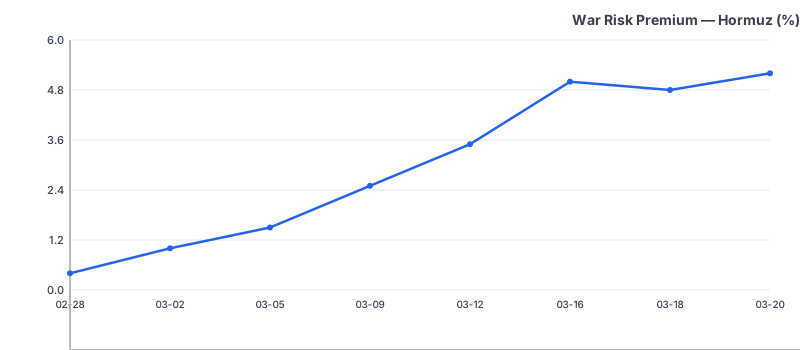
Premium Timeline
| Date | Premium | Vessel Type | Notes | Source |
|---|---|---|---|---|
| 2026-03-20 | 5.2% | VLCC | New peak after Iranian strike on South Pars gas platform | seed |
| 2026-03-18 | 4.8% | VLCC | Slight easing after Omani diplomatic talks reported | seed |
| 2026-03-16 | 5% | VLCC | Peak — near-uninsurable. SPR release announced same day | seed |
| 2026-03-12 | 3.5% | VLCC | Lloyd's JWC emergency session, many underwriters exit market | seed |
| 2026-03-09 | 2.5% | VLCC | Iranian drone strike on UAE-flagged VLCC, market in shock | seed |
| 2026-03-05 | 1.5% | VLCC | First tanker diverted to Cape route, market confirms new rate | seed |
| 2026-03-02 | 1% | VLCC | Iran announces Hormuz closure, underwriters reprice | seed |
| 2026-02-28 | 0.4% | VLCC | US-Israeli strikes begin, JWC adds Hormuz to listed areas | seed |
War Risk Premium Context
- Pre-war baseline: ~0.125% (Jan 2026) — $125K/transit for a $100M VLCC
- Elevated: 0.5–1% — ships begin rerouting via Cape of Good Hope
- High risk: 1–3% — many operators opt out; effective partial blockade
- Extreme: >3% — near-uninsurable; equivalent to de facto blockade
- Historical comparison: Red Sea/Houthi crisis (2024) peaked at ~0.7%; 1980s Tanker War ~1–2%
- Extreme premiums function as a de facto blockade even when the strait is physically open
Baltic Dry Index — History
xychart-beta
    title "Baltic Dry Index"
    x-axis ["01-22", "02-02", "02-11", "02-20", "03-03", "03-12"]
    y-axis "Points" 0 --> 2797
    line [1776, 1835, 1754, 1821, 1817, 2595]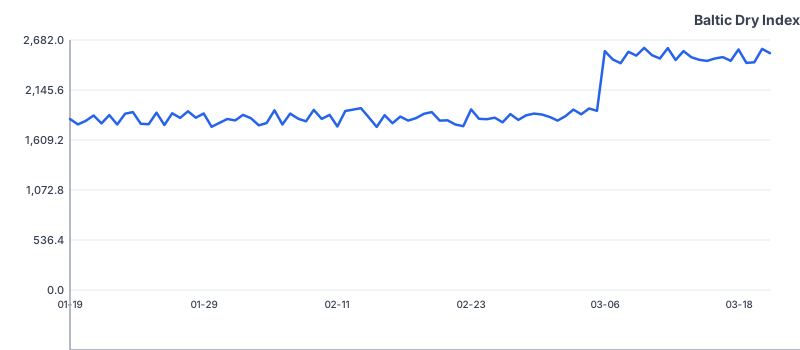
Shipping News
- 2026-03-22 — ‘Opening Strait of Hormuz will probably require US boots on the ground’ Military analysts assessed that reopening the Strait of Hormuz would likely require a ground operation by US forces, signaling that the waterway's closure could persist far longer than markets had priced in. The prospect of a prolonged blockade reinforced expectations of sustained elevated shipping costs, extended rerouting via the Cape of Good Hope, and continued disruption to roughly 20% of global oil and 50% of globally traded urea transiting the strait. For market watchers, this suggested that war risk insurance premiums, freight rates, and energy prices would remain at crisis-level elevations with no near-term relief in sight.
- 2026-03-21 — UK allows US to use bases to strike Strait of Hormuz targets The UK's decision to permit US military operations from British bases against targets near the Strait of Hormuz signaled a major escalation in Western efforts to reopen the critical waterway, through which roughly 20% of global oil and 17% of LNG shipments transit. War risk insurance premiums for vessels in the Persian Gulf were likely to spike further, pushing more operators to reroute via the Cape of Good Hope and adding 10–15 days of transit time plus significant fuel costs. The move reinforced expectations of prolonged supply disruption for crude oil, LNG, and Gulf-origin urea fertilizer, keeping upward pressure on energy and agricultural input prices.
- 2026-03-21 — Iran ready to let Japanese vessels transit Hormuz: Report Iran signaled willingness to allow Japanese-flagged vessels to transit the Strait of Hormuz, suggesting a selective reopening strategy that could fracture the unified international response to the blockade. This move would give Japan preferential access to Gulf crude and LNG supplies, potentially driving a wedge between Western allies and creating a two-tier pricing system where nations with bilateral Iran deals pay less for transit. For shipping markets, selective passage would complicate war risk insurance pricing and could pressure other importing nations — particularly South Korea and India — to negotiate their own transit arrangements, gradually eroding the blockade's effectiveness while strengthening Iran's diplomatic leverage.
- 2026-03-21 — Iran ready to help Japan ships pass through Strait of Hormuz, Araghchi says Iran's foreign minister Araghchi signaled Tehran's willingness to facilitate Japanese shipping through the Strait of Hormuz, suggesting selective passage agreements could emerge even amid the broader blockade. This represented a significant diplomatic development, as it indicated Iran might use transit access as leverage to fracture the coalition against it, potentially offering preferential terms to non-belligerent nations. For shipping markets, any reopening — even partial and conditional — would ease war risk insurance premiums on selected routes, though it would also create a two-tier transit system that kept overall freight rates elevated for vessels without Iranian guarantees.
- 2026-03-20 — Sri Lanka says it denied US request to land two aircraft at Mattala airport Sri Lanka's denial of a US military aircraft landing request at Mattala airport signaled the island nation's reluctance to be drawn into the US-Iran conflict, reflecting broader diplomatic tensions across the Indian Ocean region. The decision highlighted potential complications for US naval logistics and force projection in a critical shipping corridor connecting the Persian Gulf to Asian markets. For shipping markets, any erosion of US basing and refueling access in the Indian Ocean could complicate convoy protection and maritime security operations, potentially keeping war risk premiums elevated for vessels transiting between the Gulf and East Asia.
Last updated: 2026-03-23 | Sources: Baltic Exchange, Freightos, Lloyd's/JWC underwriter reports